Research

Power Failures: Development, Sovereignty, and Environmental Justice in Lebanon
My first book project, Power Failures: Development, Sovereignty, and Environmental Justice in Lebanon, recovers the primacy of river basin development and equitable resource distribution in twentieth-century Middle Eastern conceptions of and efforts to achieve postcolonial sovereignty. In the 1950s, engineers, activists, and village committees across the Middle East argued that water distribution was essential to justice and equality, and building water infrastructure essential to building a sound postcolonial order. However, in recent decades, historians have neglected the powerful resonance of such analyses. Historians of the Middle East and, more broadly, the Global South have interrogated the cultural, intellectual, and diplomatic aspects of how former colonies sought to establish meaningful sovereignty. Simultaneously, historians of empire and development have typically studied the development era from the perspective of international institutions, footloose Western experts, and their archives, but neglected local and regional dynamics.
Power Failures makes this argument through the history of efforts to develop the Litani River in Lebanon. It is a transnational history that analyzes how local stakeholders, national institutions, and global networks each drove postcolonial development. Arab engineers, religious leaders, and rural communities debated and pursued resource development as a means to fuel their different visions of progress, address inequalities, and build self-sufficiency. My research demonstrates how and why these local stakes, debates, and conceptions of progress shaped such projects more durably than international imperatives. It reveals how the long-term life of dams and canals—from design, to construction, to maintenance—create and foreclose opportunities for movements for popular sovereignty and economic rights.
You can learn more about my book project in this blog post for Cardiff University and in this interview at the Khayrallah Center for Lebanese Diaspora Studies at NC State University.

Between 1951–55, the US Bureau of Reclamation conducted research in Lebanon to plan a hydroelectric and irrigation scheme using Lebanon's largest river, the Litani. Their research would later form the basis of the Litani project, Lebanon's largest development scheme until the 1990s. In the shadow of that project, communities in the Litani River basin worked to enroll these US technical assistance researchers and their technologies into fulfilling their urgent needs for potable water. This article argues that these enrollments comprised ‘vernacular development’, a highly contingent, bottom-up strategy that the intended subjects of development deployed in their encounters with agents of international development. Vernacular development was a mode of interaction that interrupted and subverted the technological and temporal framework animating midcentury international development. That framework promised elaborate works in the future, which almost never materialized. Through vernacular development strategies, Litani communities identified their own material needs and goals and experimented with strategies to enroll international researchers into attaining them. They derived these strategies from their experience with successive imperial and corporate planning missions that had come and gone in the decades prior to the postwar development era. Exploring hitherto unexamined agrarian sources in the US National Archives, this article contributes to the historiography of international development and the postcolonial Middle East.

This article was a chance for me to experiment with the methods of historical political ecology. It argues that the present ecological catastrophe in the Litani River basin derives from the historical constitution of Lebanon's environmental regulatory apparatus as mediators of flows of capital that generate ecological fragility, or “capitalogenic flows.” In 2021, a massive fish kill brought the Litani River basin's spectacular ecological degradation to global attention. In response, the Litani River Authority (LRA), the Lebanese agency that manages the basin, launched a campaign against “environmental crimes” that concentrated on displacing thousands of Syrian refugees and demolishing their homes. This reflects a rebranding of the LRA, which was founded in 1955 to coordinate a World Bank loan for hydroelectric infrastructure on the Litani. Rather than commodify the water itself for irrigation or drinking—which might entail pollution controls—the Bank monopolised the basin landscape as an energy resource. Prevented from accessing the river, Litani communities have repeatedly reasserted popular sovereignty. The paper situates that history in the context of the institutional formation of Lebanon's environmental regulatory apparatus. Unlike postcolonial countries subjected to neoliberal dispossession after 1980, decades of contested institution-building from Lebanon's origins arrayed the state and its regulatory capacities around capitalogenic flows and the organised abandonment of the country's rural surplus population.

This article won the 2023 Martha Trescott prize from the Society for the History of Technology. It writes engineers into the history of Lebanese political-economic thought. Historians of Lebanon’s post-independence period have emphasized how a narrow, elite “consortium” espoused a national ideology that authorized laissez-faire monetary and trade policies. These intellectuals and businessmen invoked environmental determinism to claim that trade, tourism, and services were Lebanon’s national vocation. This article reveals that engineers formed an influential and under-examined counter- current advocating statist developmentalism. Engineer-bureaucrats saw the post-independence era as an opportunity to claim their professions’ status and redefine bourgeois culture and its relationship to governing institutions according to their conceptions of modernity. By reinterpreting the consortium’s environmental narrative of Lebanese history, the hydrological engineer Ibrahim Abd-El-Al portrayed rational development of water resources and agriculture as an organic expression of national identity. These efforts cultivated a critical and technically literate reading public that favored statism, and shaped how that public understood their national subjectivity and relationship to the natural world.
Teaching

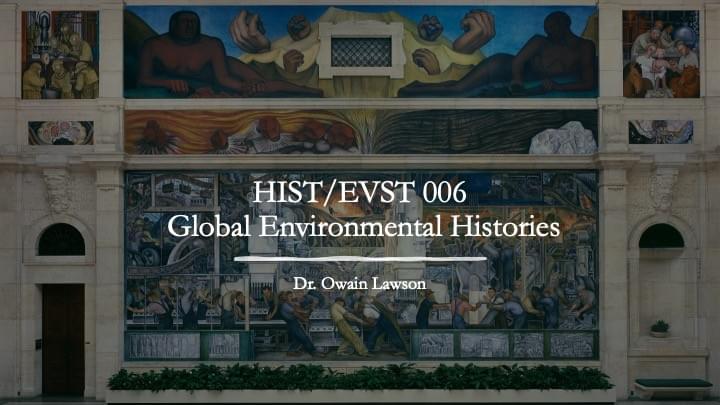
HIST/EVST 006 Global Environmental History
This course explores how environmental forces have shaped the history of modern societies and how societies have shaped their environments. By examining interconnected global case studies, we will explore key themes through the lens of environment, including empire, industrialization, borders, and gender. We will encounter histories of pollution, resource extraction and its afterlife, cultural understandings of nature, animals and insects, natural disasters, and the toxic legacy of war.

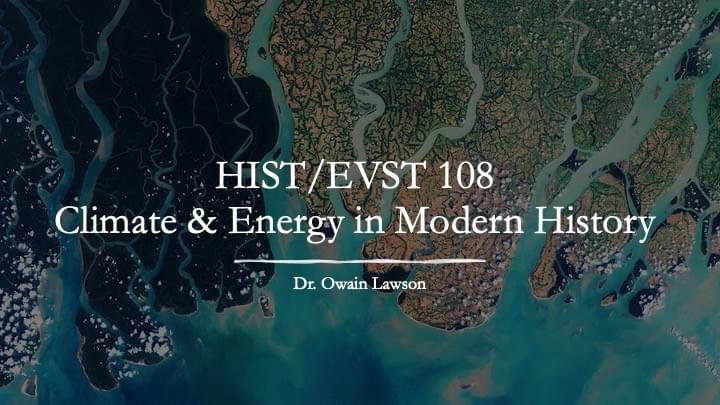
HIST/EVST 108 Climate & Energy in Modern History
This course examines the historical roots of the climate emergency. Focused on the history of energy, we will explore how empire, industrialization, and fossil fuels remade societies around the world in the 19th and 20th centuries. Through global case studies, we will encounter histories of energy regimes, extractivism, plastics, electricity, wildfires, weather events, disasters and disaster response, and the emergence and suppression of climate science and climate politics.

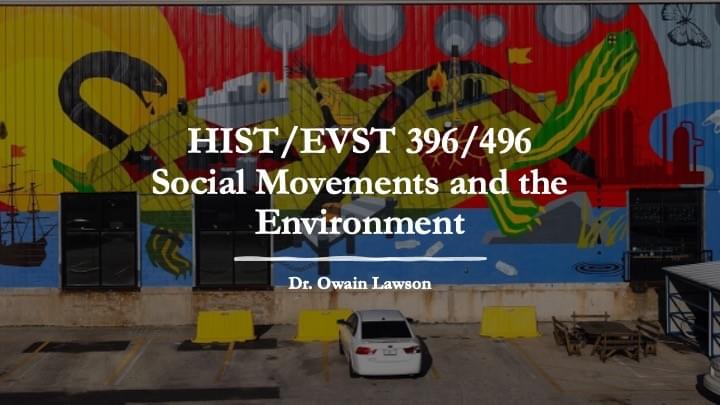
Social Movements and the Environment
This course examines critical historical perspectives on social movements and the environment. Through global case studies, we will explore the diverse concepts, methods, and strategies that social movements have used to understand and respond to environmental problems in different places and times. Topics explored include environmentalism, environmental justice, conservationism, diet reform, energy protests, industrial disease, nuclear power and weapons, urban pollution, pipeline politics, environment and war.

Teaching Prior to Current Appointment
Environmental Histories
World History 1750–2010
Environmental History of the Middle East
Incarceration in the Modern Middle East
Social History of Development in the Modern Middle East
History of the Middle East and North Africa I: From the Rise of Islam to 1800
History of the Middle East and North Africa II: From 1800 to the Present
Contact Me

The plenary session "Science, the State, and Second Nature," History of Science Society, 2022

owl324@
lehigh.edu 
Photo by Rosen-Jones Photography